


The promise of CI/CD has always been clear: ship faster, ship smarter, and catch issues before they reach production. But here's what most teams are discovering—speed without quality is just velocity toward failure.
As release cycles compress from weeks to days to hours, traditional testing approaches are buckling under the pressure. Manual testing? Can't keep pace. Scripted automation? Too brittle and maintenance-heavy. The bottleneck has shifted from deployment capability to quality assurance, and it's costing teams dearly in both time and confidence.
Enter AI agents in test automation. Not the buzzword variety—the kind that actually understands intent, adapts to change, and operates autonomously within your pipeline. This isn't about replacing your existing CI/CD infrastructure. It's about augmenting it with intelligence that makes continuous quality actually achievable at scale.
The CI/CD Quality Gap
Let's be honest about where most teams are today.
You've invested in Jenkins, GitHub Actions, GitLab CI, or Azure DevOps. Your pipelines are humming. Code gets committed, builds get triggered, and deployments happen automatically. It's beautiful—until a bug slips through.
The gap isn't in your deployment pipeline. It's in the quality signal feeding into it.
Traditional test automation in CI/CD looks like this:
- Tests run on every commit (or should)
- Half of them are flaky, so you ignore failures
- The other half break whenever UI changes happen
- Maintenance eats up 30-40% of your QA capacity
- Coverage stays stagnant because writing new tests is painful
- Production incidents happen anyway
Sound familiar?
The fundamental problem is that conventional automation can't keep up with modern development velocity. Your application is evolving faster than your test suite can adapt. And every pipeline run becomes a coin flip: are these failures real issues or just noise?
What AI Agents Actually Do
AI agents in test automation represent a fundamentally different approach. Instead of executing rigid scripts, they understand context, make decisions, and operate with a degree of autonomy that mirrors how a skilled tester thinks.
Here's what that looks like in practice:
Intent-driven test creation: Rather than manually scripting every click and assertion, you describe what you want to validate. The AI agent translates requirements, user stories, or test cases into structured, executable tests that follow best practices and leverage reusable components.
Autonomous failure analysis: When tests fail in your pipeline, the AI agent immediately investigates. It analyzes DOM snapshots, network activity, screenshots, and execution logs to determine root cause. Is it a legitimate bug? An environmental issue? A timing problem? You get answers in seconds, not hours.
Self-healing execution: Minor UI changes no longer break your entire suite. AI agents adapt in real-time, using both visual recognition and code-based locators to maintain test stability even as your application evolves.
Intelligent insights: Beyond pass/fail results, AI agents identify patterns, anomalies, and areas of risk across your application. They flag potential issues before they become critical and help prioritize what actually needs attention.
This isn't theoretical. Teams using AI-powered testing platforms are achieving 85% reductions in test maintenance, 10x faster test creation, and coverage levels that were previously impossible to maintain.
Building the Integration
Integrating AI agent capabilities into your CI/CD pipeline doesn't require ripping out your existing infrastructure. It's about augmenting what you have with intelligence that makes every pipeline run more valuable.
Pipeline Triggers and Orchestration
The beauty of modern test automation platforms is that they slot right into your existing workflows. Whether you're using Jenkins, GitHub Actions, Azure DevOps, GitLab, CircleCI, or Bamboo, integration is straightforward.
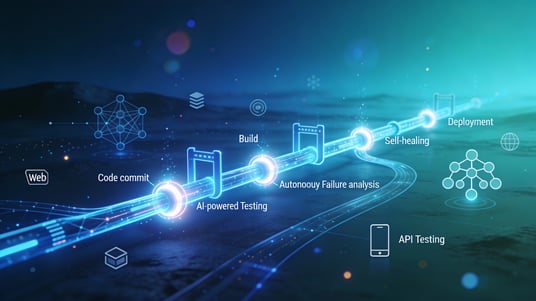
Your pipeline configuration might look something like this: code gets committed, build runs, AI-powered test suite executes in parallel across environments, results flow back with detailed diagnostics, and deployment gates automatically based on quality signals.
But here's where AI agents change the game—they're not just running tests. They're analyzing your application state, adapting to changes on the fly, and providing context-rich feedback that helps teams make informed decisions about whether to proceed with deployment.
Parallel Execution at Scale
One of the biggest advantages of cloud-native AI testing platforms is unlimited parallelization. Your entire test suite—web, mobile, API, accessibility, performance—can run simultaneously across multiple environments and configurations.
This means comprehensive testing that used to take hours now completes in minutes. Your pipeline doesn't slow down as coverage expands. Instead, quality becomes a accelerator rather than a bottleneck.
Real-Time Feedback Loops
Speed matters, but only if the feedback is actionable. AI agents provide immediate, specific insights directly in your pipeline results:
When a test fails, you don't just see "Element not found." You see the root cause analysis, the exact point of failure with visual evidence, recommendations for resolution, and whether similar patterns exist across other tests.
This intelligence integrates seamlessly with your existing tools. Failed tests can automatically create Jira tickets with full diagnostic context. Slack or Teams notifications include not just pass/fail status but actual insights about what changed and why. Your team spends less time investigating and more time fixing.
From Reactive to Proactive Quality
Here's where AI agents really transform CI/CD: they shift you from reactive testing to proactive quality engineering.
Continuous Coverage Expansion
Traditional automation creates a perverse incentive—writing new tests is so painful that teams stop expanding coverage once they hit "good enough." With AI-powered test creation, expanding coverage becomes trivial.
Need to validate a new user journey? Describe the workflow in natural language and generate the test outline in seconds. Want to ensure accessibility compliance across new features? Leverage existing functional tests to automatically perform unlimited accessibility checks. Concerned about performance regression? Reuse your functional tests for load testing without writing separate scripts.
This continuous expansion of coverage happens organically within your pipeline, not as a separate initiative that requires dedicated sprints.
Adaptive Quality Gates
Not all test failures are created equal. AI agents help you set intelligent quality gates that consider context, risk, and patterns.
A legitimate bug in checkout flow? Block deployment. A visual regression in a low-traffic page that's already been reviewed? Flag it but don't block. Environmental flakiness that's been identified and categorized? Ignore it.
This level of intelligence prevents two common CI/CD antipatterns: blocking deployments for false positives (which trains teams to ignore tests) and letting real issues slip through because the signal-to-noise ratio is too low.
Shift-Left Intelligence
AI agents don't just run at the end of your pipeline. They provide intelligence throughout the development process.
Developers can run tests locally before committing, getting immediate feedback on whether their changes break existing functionality. Pull requests automatically trigger relevant test suites based on code changes, focusing testing effort where it matters. Pre-production environments get continuous testing that identifies issues before they reach staging or production.
This shift-left approach means issues get caught earlier, when they're cheaper and easier to fix. Your pipeline becomes less about catching problems and more about confirming quality.
Making It Real
The shift to AI-powered continuous quality isn't a rip-and-replace initiative. It's an evolution of what you're already doing.
Start by identifying your biggest pain points. Is it test maintenance? Coverage gaps? Flaky results? Time to feedback? Pick one area where the friction is highest and let AI agents solve that specific problem within your pipeline.
The teams seeing the most success aren't trying to boil the ocean. They're integrating intelligence incrementally, proving value quickly, and expanding from there.
Because here's the thing about continuous quality—it's not just about running tests continuously. It's about continuously improving your ability to deliver reliable software at speed.
AI agents make that possible. They bring intelligence, adaptability, and scale to the CI/CD pipelines you've already built. The infrastructure you have is fine. It just needs to be smarter.
That's the difference between shipping fast and shipping fast with confidence.
Ready to transform your CI/CD pipeline with AI-powered continuous quality? Start your free trial of mabl today and experience intelligent test automation that actually keeps pace with your release velocity.
Get You Demo Today!
Our AI-powered testing platform is a continuous testing platform that can transform your software testing quality, integrating automated end-to-end testing into the entire software development lifecycle.

.png?width=400&height=200&name=Untitled%20(32).png)