Merge with confidence
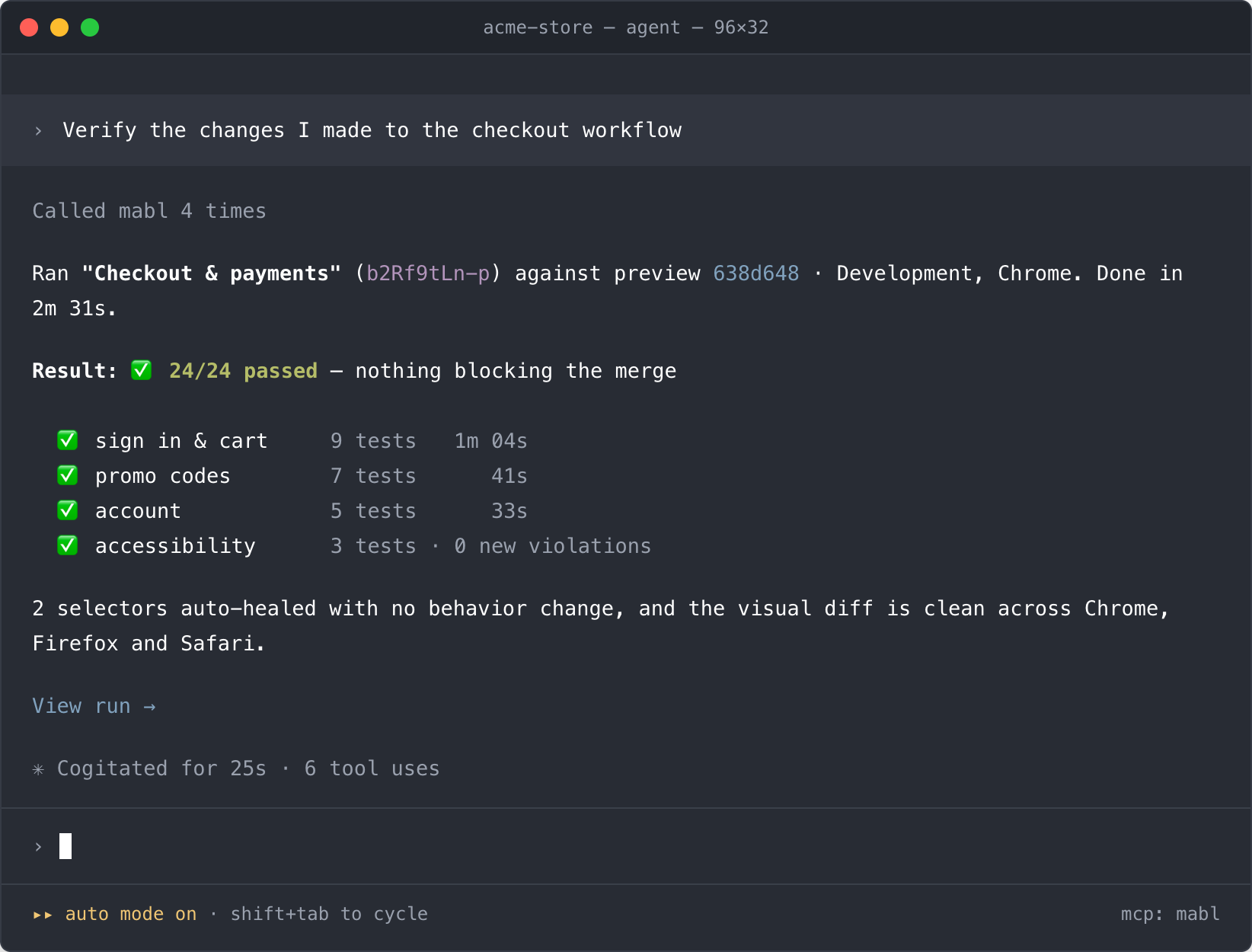
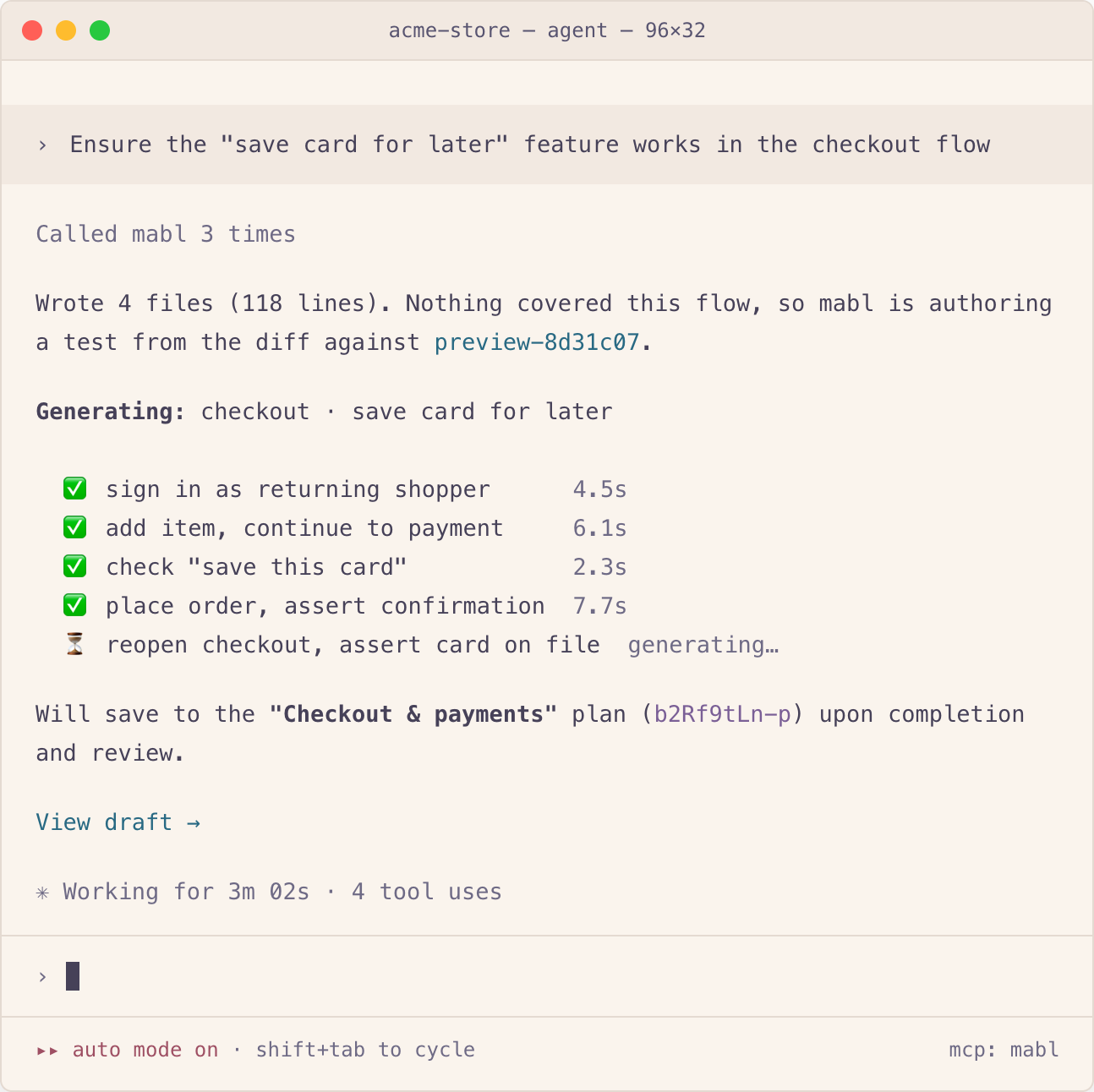
Integrate with your coding agent for fast E2E testing
Connect the mabl MCP server or CLI, and your agent can test changes in your target environments and troubleshoot failures. All from your IDE or terminal.

The world's most advanced testing harness
The engineering underneath: independent, reliable, resilient.
-
Per-task LLM routing
The best model for each testing job. You don't need to worry about upgrades, prompt rewrites, version pinning, or evals.
-
Reliable tools for your agent
An MCP for the full testing loop. Broad tool coverage, progressive disclosure, idempotent writes, token-efficient, streaming with keepalive, OAuth.
-
Self-healing off a model, not a selector
Every element is modeled as dozens of weighted attributes, so a page change re-identifies it by best overall match, falling back to locating it visually when attributes aren't enough.
-
Structural objectivity
An LLM told to make a test pass will edit the DOM or weaken the assertion to get there. mabl runs your deployed app in a real browser, in a separate context, and checks it against assertions you defined separately.
-
Your intent, translated
You describe what to test and set your guardrails; mabl's tuned metaprompts turn that into the structured instructions the agent runs on, scoped per agent with mabl's own guardrails winning on conflict. You get an effective agent without prompt-engineering it yourself.
-
Deterministic first, LLM when needed
Cheap deterministic locators run first; the model engages only when they fail. More efficiency, lower cost, faster.
The world's most advanced testing harness
The engineering underneath: independent, reliable, and resilient.
Per-task LLM routing
The best model for each testing job. You don't need to worry about upgrades, prompt rewrites, version pinning, or evals.
Reliable tools for your agent
An MCP for the full testing loop. Broad tool coverage, progressive disclosure, idempotent writes, token-efficient, streaming with keepalive, OAuth.
Self-healing off a model, not a selector
Every element is modeled as dozens of weighted attributes, so a page change re-identifies it by best overall match, falling back to locating it visually when attributes aren't enough.
Structural objectivity
An LLM told to make a test pass will edit the DOM or weaken the assertion to get there. mabl runs your deployed app in a real browser, in a separate context, and checks it against assertions you defined separately.
Your intent, translated
You describe what to test and set your guardrails; mabl's tuned metaprompts turn that into the structured instructions the agent runs on, scoped per agent with mabl's own guardrails winning on conflict. You get an effective agent without prompt-engineering it yourself.
Deterministic first, LLM when needed
Cheap deterministic locators run first; the model engages only when they fail. More efficiency, lower cost, faster.