Stand by what you ship
The world's most advanced testing harness
The engineering underneath: independent, reliable, resilient.
-
Per-task LLM routing
The best model for each testing job. You don't need to worry about upgrades, prompt rewrites, version pinning, or evals.
-
Reliable tools for your agent
An MCP for the full testing loop. Broad tool coverage, progressive disclosure, idempotent writes, token-efficient, streaming with keepalive, OAuth.
-
Self-healing off a model, not a selector
Every element is modeled as dozens of weighted attributes, so a page change re-identifies it by best overall match, falling back to locating it visually when attributes aren't enough.
-
Structural objectivity
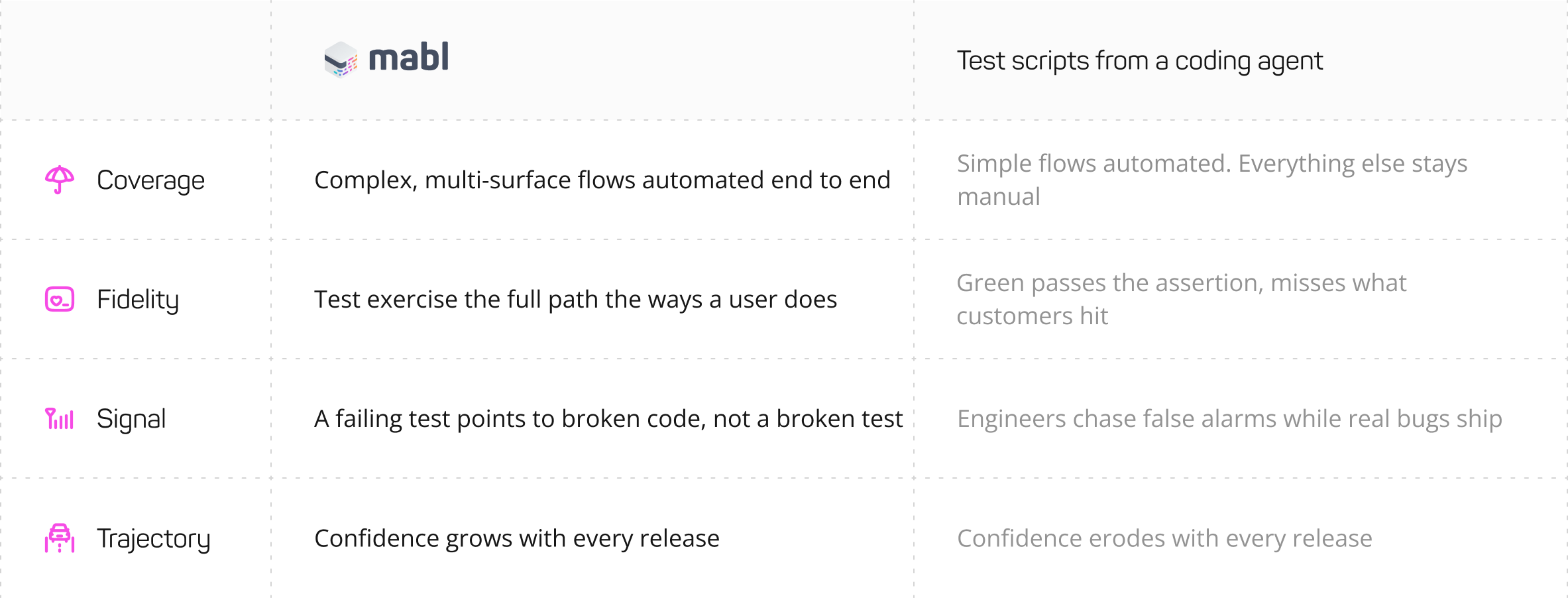
An LLM told to make a test pass will edit the DOM or weaken the assertion to get there. mabl runs your deployed app in a real browser, in a separate context, and checks it against assertions you defined separately.
-
Your intent, translated
You describe what to test and set your guardrails; mabl's tuned metaprompts turn that into the structured instructions the agent runs on, scoped per agent with mabl's own guardrails winning on conflict. You get an effective agent without prompt-engineering it yourself.
-
Deterministic first, LLM when needed
Cheap deterministic locators run first; the model engages only when they fail. More efficiency, lower cost, faster.
All your complex workflows, automated end-to-end
Agentic test generation
Create reliable tests from natural language intent and your agent’s context, validated to work.
Web, API, and mobile testing
Cover all your app surfaces, instead of stitching together tools and frameworks.
Email, file, and database validation
Automate the validation of email workflows, file content, and database accuracy.
Test like real users, at scale
Unlimited parallelization
Execute thousands of tests in the mabl cloud for fast results from large test suites.
Visual finds and assertions
Define test actions and assertions with natural language, without relying on DOM content alone.
Trust the signal, remove the noise
Agentic failure analysis
Every failed run returns an explanation with evidence and recommendations, optimized for agent consumption.
Agentic auto-healing
Instead of failing, tests adjust to unexpected selector changes and UI shifts while preserving intent.
Test reliability reporting
Understand and track test suite health to eliminate time spent on false alarms.
Reliable insights into your release quality
Precise, change-aware quality signals that understand your business and application context.
-
Read the Leading Reach customer story
0
Bugs in production

-
Read the Priceline customer story
100,000
E2E tests running each month
-
Read the SealingTech customer story
86%
Reduction in test execution time

-
10x
Faster test creation
-
Read the JetBlue customer story
9x
Faster test execution
-
Read the Momentum energy customer story
90%
Less time spent on suite maintenance

-
Read the Priceline customer story
80%
Coverage on core features
-
Read the LeadingReach customer story
2x
Faster releases
Ship bug-free releases with confidence
Frequently Asked Questions
What is regression testing?
Regression testing checks that existing features still work after a code change. Teams rerun it before each release to catch what new work broke. mabl automates end-to-end regression coverage across web, API, and mobile and runs large suites in parallel.
What is end-to-end testing?
End-to-end testing verifies a complete user workflow in the running application, across the interface, APIs, and connected systems. It catches failures that unit tests miss. mabl also validates the parts of a workflow outside the browser, like emails, files, and database records.
What is a flaky test?
A flaky test passes and fails on the same code without any application change. Common causes include timing issues, unstable test data, and brittle selectors. Flaky tests erode trust in results, because teams start ignoring failures that might be real.
How do you handle flaky tests in an automation suite?
Separate real failures from noise, then fix the cause instead of rerunning. mabl’s agentic failure analysis explains each failed run with evidence, auto-healing adjusts to selector and UI changes, and reliability reporting tracks suite health over time.
How do you know a release is ready to ship?
A release is ready when critical user journeys pass and the team trusts those results. That takes reliable tests, clear failure explanations, and quality signals tied to what changed. mabl provides change-aware quality signals, while your team makes the final release call.