


Key Takeaways
- Generative AI in software testing creates and analyzes test assets. That includes test cases, scripts, test data, and failure summaries.
- Faster test generation isn’t stronger verification. Code and tests written from the same prompt can share the same blind spots.
- The author can’t be the only verifier. AI-generated code needs independent quality criteria and evidence.
- Use generative AI as a challenger, not the final judge. It works best for adversarial test ideas, change mapping, and failure triage.
- Agentic testing connects the full lifecycle. It links authoring, execution, failure analysis, and recovery. People still own release decisions.
Generative AI in software testing uses AI to create and analyze test assets. These outputs can include test cases, automation scripts, test data, assertions, documentation, and failure summaries.
Used well, generative AI can help teams expand coverage and respond faster to software changes.
Faster test generation does not automatically produce stronger verification.
As AI coding agents increase the volume of code entering development pipelines, engineering teams need an independent way to determine whether those changes meet their quality standards.
If the same assumptions shape both the code and its tests, teams risk releasing defects with a misleading sense of confidence.
Generative AI can support authoring, failure analysis, and maintenance. Agentic systems can connect those capabilities to execution and recovery, while teams retain control over quality, intent and release decisions.
What Is Generative AI in Software Testing?
Generative AI refers to models that produce new content based on prompts, source material, and other context. In software testing, that content might include:
- Test scenarios derived from requirements
- Automated test scripts
- Assertions for expected application behavior
- Test data and edge-case ideas
- Explanations of test failures
- Suggested updates for broken tests
- Summaries of release risk and coverage
A practical generative AI in software testing framework connects these outputs to quality goals. A team might ask AI to convert a user story into scenarios, explain a regression, or identify workflows affected by a change.
This differs from testing applications that contain generative AI features, which requires evaluating nondeterministic outputs, model behavior, safety, and reliability. Teams testing AI features can use model calls within their tests.
Tip: Our guide to integrating generative AI into end-to-end testing includes examples of generated inputs and AI-assisted evaluation of outputs.
Why AI-Generated Code Can Create a Verification Problem
AI coding agents can help developers produce features, refactor code, and resolve issues faster. The resulting increase in delivery throughput also raises the amount of code that needs to be verified.
The central concern is independence. If an AI system writes code and then generates tests from the same instructions, both outputs may inherit the same misunderstanding. A requirement omitted from the prompt may be absent from the implementation and its test. The generated test may also mirror the code's structure rather than validate the intended user outcome.
In other words, the author cannot be the only verifier. Developer-authored tests still provide useful feedback, but they should not serve as the only evidence for a release. Teams also need checks grounded in independent quality criteria, application behavior, historical evidence, and business-critical workflows.
Higher code volume also increases the need for auditability. Engineering and quality leaders need traceable evidence showing what was tested, which failures remain unresolved, and why a release meets the team's standards.
Teams can build their own verification harness around AI-generated code. Doing so requires architecture, integrations, model governance, test infrastructure, observability, access controls, reporting, and ongoing maintenance.
Engineering leaders should compare those ownership costs with a purpose-built system that provides independent quality context and release evidence.
Generative AI vs. Traditional Automation vs. Agentic Testing
Traditional automation, generative AI, and agentic testing can all contribute to software quality. These categories overlap rather than represent mutually exclusive technologies. Agentic testing can use generative models, while traditional automation can provide the execution foundation for agentic workflows.
|
Area |
Traditional automation |
Generative AI in testing |
Agentic testing |
|
Unit of work |
Predefined checks and rules |
Generated content or analysis |
Goals and multistep testing workflows |
|
Required context |
Explicit test logic and inputs |
Prompts and supplied source material |
Application, test, quality, and historical context |
|
Lifecycle reach |
Executes predefined checks; related work is often configured separately |
Supports individual creation or analysis tasks |
Coordinates authoring, execution, analysis, and recovery |
|
Adaptability |
Behavior changes often require rule or script maintenance |
Generates suggestions or revised assets |
Observes results and selects permitted next actions |
|
Human role |
Authors, reviews, and maintains automation |
Prompts, reviews, and approves output |
Defines quality intent, autonomy, and release standards |
|
Verification independence |
Depends on how tests and criteria were created |
May repeat the code author's assumptions |
Depends on separate quality criteria, context, evidence, and governance |
Generative AI usually addresses a particular task. Agentic testing connects capabilities into a broader workflow that can interpret a goal, take approved actions, observe results, and adjust its approach. Teams establish the standards and boundaries.
How Generative AI Can Help Test AI-Generated Code
Generative AI is most useful here as a challenger and investigative aid, not as the final authority on whether its own code is correct. It can help teams examine AI-generated changes from several angles:
- Compare the change with the original request. Generative AI can compare the full diff with the ticket, acceptance criteria, or specification and flag files, behaviors, or dependencies that appear outside the requested scope. A reviewer must still inspect the actual changes.
- Turn requirements into adversarial test ideas. Ask a separate testing workflow to challenge the implementation with invalid inputs, expired credentials, malformed payloads, boundary values, interrupted transactions, concurrent actions, and unexpected state changes. These cases are more likely to expose assumptions shared by the generated code and its happy-path tests.
- Identify dependencies and APIs that need verification. Generative AI can surface newly introduced packages, methods, endpoints, or version assumptions. Teams should confirm them through trusted registries, vulnerability databases, API documentation, and dependency-scanning tools rather than relying on model knowledge.
- Map the change to affected behavior. A model can help connect modified files and interfaces to user journeys, service contracts, authorization boundaries, and downstream integrations. That map gives teams a starting point for choosing unit, API, integration, and end-to-end coverage.
- Audit AI-generated test changes. Generative AI can help reviewers locate deleted tests, weakened assertions, new mocks, or tests that simply restate the implementation. These types of patterns can make a suite pass while reducing the evidence it provides.
- Turn failure artifacts into testable hypotheses. Generative AI can summarize logs, screenshots, network activity, and run history, then suggest the next check. Investigators should confirm every explanation against the underlying evidence before accepting a code or test change.
These uses make generative AI helpful for testing AI-generated code without treating another generated answer as proof. Deterministic tools, independent criteria, execution evidence, and human judgment remain the sources of trust.
How to Test AI-Generated Code Step by Step
Testing AI-generated code requires more than running the tests the coding agent produced. Use the following process to establish independent expectations, challenge the change, and preserve evidence for the release decision.
1. Capture the Intended Scope and the Full Change
Collect the original ticket, acceptance criteria, architecture notes, and relevant business rules. Review the complete diff, including tests, lockfiles, dependencies, build scripts, CI configuration, agent instruction files, and infrastructure code. Record which components, interfaces, and user journeys may be affected.
2. Inspect the Change Before Executing It
Run the repository’s required build, type, lint, static-analysis, secret-scanning, and dependency checks. Verify every new package and version against trusted registries and vulnerability sources.
OWASP’s secure coding guidance for AI also recommends reviewing every changed file and scrutinizing out-of-scope edits, rather than approving an agent-generated pull request based on its summary.
3. Define Expected Behavior Independently
Write down the expected behavior before using the generated implementation as evidence. Base those expectations on acceptance criteria, API contracts, business rules, established application behavior, and security requirements. The code and tests may share the same mistake, so neither should define correctness on its own.
4. Build a Change-Specific Test Matrix
List the happy path and the failure modes most relevant to the change. Include invalid inputs, authorization boundaries, error handling, boundary values, state transitions, concurrent actions, compatibility concerns, and interrupted workflows where applicable. Assign each scenario to the unit, API, integration, or end-to-end layer that can verify it most directly. Use manual exploratory testing for novel or ambiguous behavior that structured checks may miss.
5. Generate and Review Tests Defensively
Use generative AI to draft missing cases, fixtures, and assertions, then inspect what each test proves. Flag deleted tests, weaker assertions, excessive mocking, and tests that assert the generated behavior instead of the required behavior. Require independent review for security-critical paths such as authentication, authorization, input validation, and cryptographic operations.
6. Run Targeted Checks, Then Expand Based on Risk
Start with fast deterministic checks and tests mapped to the change. Use Test Impact Analysis or an equivalent change-based method to identify related coverage. Then run broader integration and regression suites when the affected journey, dependency, or release policy requires them. Record any tests that were intentionally excluded.
7. Investigate Failures and Verify Every Repair
Use screenshots, logs, network activity, application state, and test history to distinguish a defect from an environment problem or outdated automation. If AI proposes a code fix or test repair, review the new diff and rerun the failed test, adjacent scenarios, and any broader coverage affected by the repair. Do not allow the same AI action to approve its own change.
8. Produce a Release Record
Document the change scope, checks performed, tests run, test modifications, dependency findings, failures, recovery actions, and unresolved risks. Engineering and quality leaders can use that evidence to decide whether the change meets the team’s release standards. AI can organize the record, but people remain accountable for the release.
Risks and Guardrails When Using Generative AI in Testing
Generative AI introduces several risks that teams should address before increasing autonomy.
- Hallucinated tests: A model may invent unsupported requirements, application states, or APIs.
- Shallow assertions: Generated tests may confirm that a page loaded without validating the intended outcome.
- Shared blind spots: Code and tests generated from the same context may repeat the same error.
- Logic drift: Automated repairs may change what a test validates unless they preserve the original intent.
- Missing context: A model may lack application history, domain knowledge, or dependencies needed for a sound decision.
- Weak traceability: Teams may struggle to reconstruct the rationale behind an AI-generated action.
- Sensitive data exposure: Prompts and test data may contain information that an external model should not use.
- Over-automation: High autonomy without appropriate controls can turn incorrect assumptions into repeated actions.
Human oversight should focus on quality, ambiguity, consequential changes, and release decisions. AI supports quality professionals' judgment rather than replacing it.
How Agentic Testing Extends Generative AI
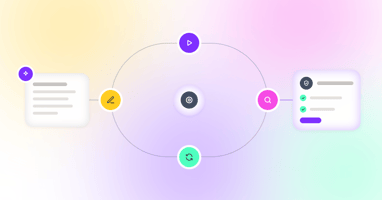
Generative AI provides content-generation and analysis capabilities. Agentic testing combines models, tools, context, and feedback to coordinate actions toward a quality goal.
A testing agent may interpret standards, author tests from approved inputs, execute them, examine results, and determine whether recovery or investigation is appropriate.
Each action benefits from shared quality context.
Active Coverage applies this approach across test creation, execution, failure analysis, and recovery. It supports coverage that creates tests, runs them, and surfaces fixes while teams define the intent, permissions, and standards for the work.
Deep Quality Context gives mabl accumulated information about the application, tests, historical behavior, and team instructions. It reduces reliance on isolated prompts and informs each action. No competitor has an equivalent source of quality context spanning the full testing lifecycle.
As AI coding agents produce more changes, connected testing workflows can provide faster feedback without sacrificing independent verification or human accountability.
The right agentic testing platform should help teams increase testing capacity while keeping quality goals and release accountability in human hands.
Build Independent Verification for AI-Generated Code
Generative AI can help teams create tests, investigate failures, and maintain coverage faster. As AI coding agents increase throughput, independent verification becomes more important.
Teams need testing systems that apply their quality standards across authoring, execution, failure analysis, and recovery while producing evidence people can trust.
See how mabl supports your agentic testing, or book a demo to explore the approach with the mabl team.
Generative AI in Software Testing FAQs
What is generative AI in software testing?
Generative AI in software testing uses AI models to create or analyze testing assets. Common applications include generating test cases, drafting automation scripts, proposing test data, explaining failures, and suggesting test repairs.
How can generative AI create test cases from requirements?
A model can analyze user stories, acceptance criteria, technical specifications, or other requirements and translate them into proposed scenarios. Teams should review those scenarios for accuracy, risk coverage, and alignment with real application behavior before using them.
How should teams test AI-generated code?
Teams should define quality standards, separate code generation from verification, create risk-based coverage, test across appropriate layers, analyze failures using evidence, and retain human responsibility for release decisions.
What is the difference between generative AI and agentic testing?
Generative AI typically generates or analyzes output in response to a prompt. Agentic testing works toward a broader goal through a connected sequence of actions, such as authoring tests, running them, analyzing failures, and recovering affected coverage.
Can generative AI replace software testers?
Generative AI can reduce repetitive work and help teams analyze more information. People remain responsible for setting quality goals, resolving ambiguous requirements, evaluating risk, governing AI actions, and determining whether a release is ready.