

Key Takeaways
- Agentic testing goes beyond test generation. AI agents handle test authoring, execution, failure analysis, and recovery.
- Teams stay in control. You set the quality standards and decide how much autonomy agents get.
- AI-generated code needs independent verification. Coding agents shouldn’t grade their own tests.
- Less maintenance and triage. Auto-healing and failure analysis cut repetitive work.
People own release readiness. Agents gather the evidence; leaders make the call.
Agentic testing is a software quality approach in which AI agents coordinate work across test authoring, execution, failure analysis, and recovery.
Teams define the quality intent, permissions, and release standards. The system carries those instructions through a connected workflow, observes results, and takes permitted next steps.
Test generation is one part of that workflow.
Creating a test does not determine when it should run, explain why it failed, keep it working as the application changes, or show whether a release is ready.
Agentic testing addresses those continuing jobs.
That distinction is essential as AI coding agents increase development throughput. More tests can help, but test volume alone does not provide a trustworthy release signal.
When coding agents also generate tests, teams still need independent verification grounded in application behavior, historical evidence, and team-defined standards.
Why Test Generation Is Only the First Job
A generated test is a starting point. It becomes useful coverage only after the team knows it runs reliably and validates the intended behavior.
From there, every application change creates more work. The testing system still needs to determine:
- Which tests are relevant to a change
- Whether a failure indicates a defect, an application update, a flaky test, or environmental noise
- Whether a test can recover without weakening its original intent
- Which unresolved risks should affect a release decision
- How to preserve evidence for engineering, quality, and compliance teams
Test generation creates an asset. Agentic testing keeps that asset useful by linking it to evidence of execution, investigation, maintenance, and release.
The value comes from continuity across those jobs, not simply from producing more test cases.
How Agentic Testing Works Across the Testing Lifecycle
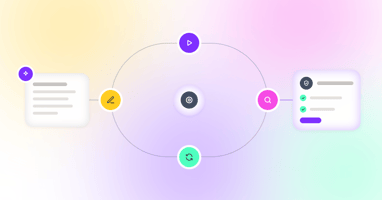
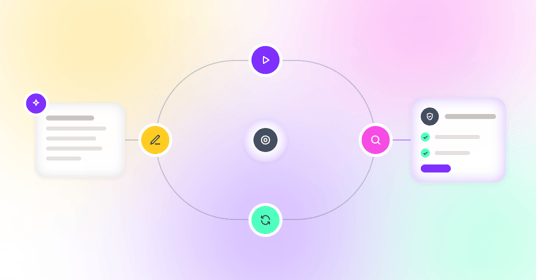
Agentic testing operates as a loop. Each stage contributes context and evidence to the next, while teams control the standards and level of autonomy.
1. Define Quality Intent
Quality leaders and engineering teams establish what the application should do and what each test must prove.
Inputs can include requirements, user stories, Jira tickets, acceptance criteria, existing tests, and application-specific instructions.
This quality context gives the system more than a completion goal. It records the workflows that matter, the behavior users expect, and the situations that require human review.
2. Author Working Coverage
Agentic test authoring turns approved inputs into runnable tests. The system can navigate the application, build the steps and assertions, replay the generated test, and correct problems before saving it.
Validation during authoring matters because automated checks with valid syntax can still catch the wrong behavior.
Teams need a clear record of what the system created and the ability to refine the result when requirements are ambiguous.
3. Execute the Tests That Matter
Execution connects generated coverage to software changes. Test Impact Analysis can identify the subset of tests related to a code change, while parallel cloud execution supports broader regression runs.
This gives developers faster feedback without treating a targeted run as a replacement for full regression coverage when risk requires it. The system can select and run permitted tests, but the team still defines the release policy.
4. Analyze Failures Before Manual Triage
A failed test does not automatically mean the application is broken. The cause may be a product regression, an application change, a flaky test, or environmental noise.
Agentic failure analysis examines evidence such as screenshots, logs, run history, retries, and application state. It can classify the likely cause and recommend a next step.
Developers and QA practitioners receive a clearer starting point, while leaders get a more credible quality signal.
5. Recover Tests Without Losing Intent
Applications change after tests are created. Adaptive auto-healing can update selectors when user interface changes affect locators. Runtime recovery can address mid-execution obstacles such as unexpected modals, stale filters, pagination changes, or unresponsive controls.
Configurable autonomy lets teams decide which recovery actions the system can take, how those actions affect the test result, and when human approval is required.
For example, the system may dismiss a known modal and continue collecting evidence while keeping the test marked as failed for review. After the team validates that behavior, it may allow the same recovery to proceed automatically. A permanent test update may still require approval before it is applied to the saved test.
Every recovery action should remain logged and reviewable. These controls help teams automate familiar, lower-risk situations without allowing maintenance to silently change what a test was intended to prove.
Together, these stages produce evidence about what ran, what failed, how the system responded, and which risks remain unresolved.
Agentic testing can organize that evidence for release-readiness decisions. People remain accountable for the final judgment.
What Makes the Workflow Agentic?
The workflow becomes agentic when the stages operate as a single system rather than as a collection of AI features.
Context persists between actions. Results influence the next permitted step. The system can continue working toward a quality goal without requiring a person to manually orchestrate every handoff.
That continuity does not mean unlimited autonomy. Teams define the quality standards, access controls, approval points, and conditions that govern the system. The agent handles operational work within those boundaries.
mabl delivers this connected workflow through Active Coverage, spanning test creation, execution, failure analysis, and recovery. It provides coverage that builds, runs, and fixes itself as the application evolves.
Deep Quality Context brings together application behavior, test history, existing coverage, and team instructions. mabl identifies this as a core differentiator because no competitor has an equivalent source of quality context spanning the full testing lifecycle.
The mabl Cloud MCP Server makes those capabilities and signals available from supported developer and quality workflows.
Traditional Automation vs. AI-Assisted Testing vs. Agentic Testing
The difference is less about whether a tool uses AI and more about how much work it can carry over from an initial task.
|
Area |
Traditional Automation |
AI-Assisted Testing |
Agentic Testing |
|
Primary unit of work |
Executes predefined checks and rules |
Helps a person complete an isolated task |
Coordinates permitted work toward a quality goal |
|
Test creation |
People define and maintain scripts, rules, or recorded flows |
AI generates or suggests tests |
The system can author from quality intent and validate generated tests before use |
|
Failure handling |
People inspect and classify results |
AI summarizes a failure or suggests a fix |
The system investigates evidence, classifies the likely cause, and recommends next steps |
|
Response to change |
Teams update affected automation |
AI may suggest selector or code changes |
Recovery adapts coverage with transparent, configurable control |
|
Context |
Usually configured for a particular test, suite, or framework |
Often focused on the current prompt or task |
Application, history, and quality context carry across stages |
|
Release signal |
Teams assemble evidence from the available results and tools |
AI provides faster insight for individual tasks |
Connected evidence supports broader release-readiness decisions |
Agentic testing can use generative AI and traditional automation underneath the workflow. The distinction lies in how the system combines those capabilities, maintains context, and continues to act within team-defined boundaries.
What Agentic Testing Changes for QA and Engineering Teams
Agentic testing changes who performs operational work and where people apply judgment.
For engineering leaders, the benefit is a stronger signal between merge and production. Independent verification can support higher throughput without asking the coding workflow to certify its own output.
Shared evidence also gives engineering, platform, quality, and compliance teams a common basis for discussing risk.
For quality leaders, less time spent on repetitive test maintenance and failure triage creates more capacity for quality strategy. Their expertise shapes standards, critical journeys, coverage priorities, and the boundaries for autonomy.
Developers and SDETs can receive faster feedback with less context switching when testing connects to their pipeline, issue tracker, and development environment. Better evidence helps them reproduce failures and confirm fixes.
People still handle decisions that require business judgment. They resolve ambiguity, govern the system, examine edge cases, and decide whether the evidence supports a release.
From Test Creation to Trustworthy Coverage
The useful question is what happens after a test is generated. Does it run when the application changes? Can the team trust the failure analysis? Can it recover without rewriting the original intent? Can leaders see the evidence behind a release decision?
If the workflow stops at test creation, it remains AI-assisted authoring. Agentic testing keeps the quality loop moving by connecting evidence from intent, execution, analysis, recovery, and release.
Explore mabl’s agentic AI test automation platform to see how Active Coverage and Deep Quality Context support independent verification.
Book a demo to see the workflow in action.
Agentic Testing FAQs
How Is Agentic Testing Different From AI Test Automation?
AI test automation often applies AI to one task, such as generating a test, summarizing a failure, or updating a locator. Agentic testing connects work across test creation, execution, failure analysis, and recovery. Context carries between stages so the system can continue toward a quality goal.
Does Agentic Testing Replace QA Teams?
No. Agentic systems can take on more authoring, execution, analysis, and maintenance work. Quality teams define standards, govern autonomy, assess coverage, investigate edge cases, and provide the judgment behind release decisions.
Can Agentic Testing Verify AI-Generated Code?
Yes, when it operates as a separate testing system with independent criteria and evidence. It can evaluate application behavior using context beyond the current diff and the coding agent's assumptions.
How Does Agentic Testing Reduce Test Maintenance?
Adaptive auto-healing can update selectors after interface changes. Runtime recovery can handle specified obstacles during execution. Configurable controls determine which actions require approval and which can happen automatically.
Can Agentic Testing Determine Release Readiness?
Agentic testing can provide stronger inputs by combining execution results, failure analysis, flakiness data, trends, and recovery history. Engineering and quality leaders remain responsible for interpreting that evidence against business risk and release criteria.