Merge with confidence
The world's most advanced testing harness
The engineering underneath: independent, reliable, resilient.
-
Per-task LLM routing
The best model for each testing job. You don't need to worry about upgrades, prompt rewrites, version pinning, or evals.
-
Reliable tools for your agent
An MCP for the full testing loop. Broad tool coverage, progressive disclosure, idempotent writes, token-efficient, streaming with keepalive, OAuth.
-
Self-healing off a model, not a selector
Every element is modeled as dozens of weighted attributes, so a page change re-identifies it by best overall match, falling back to locating it visually when attributes aren't enough.
-
Structural objectivity
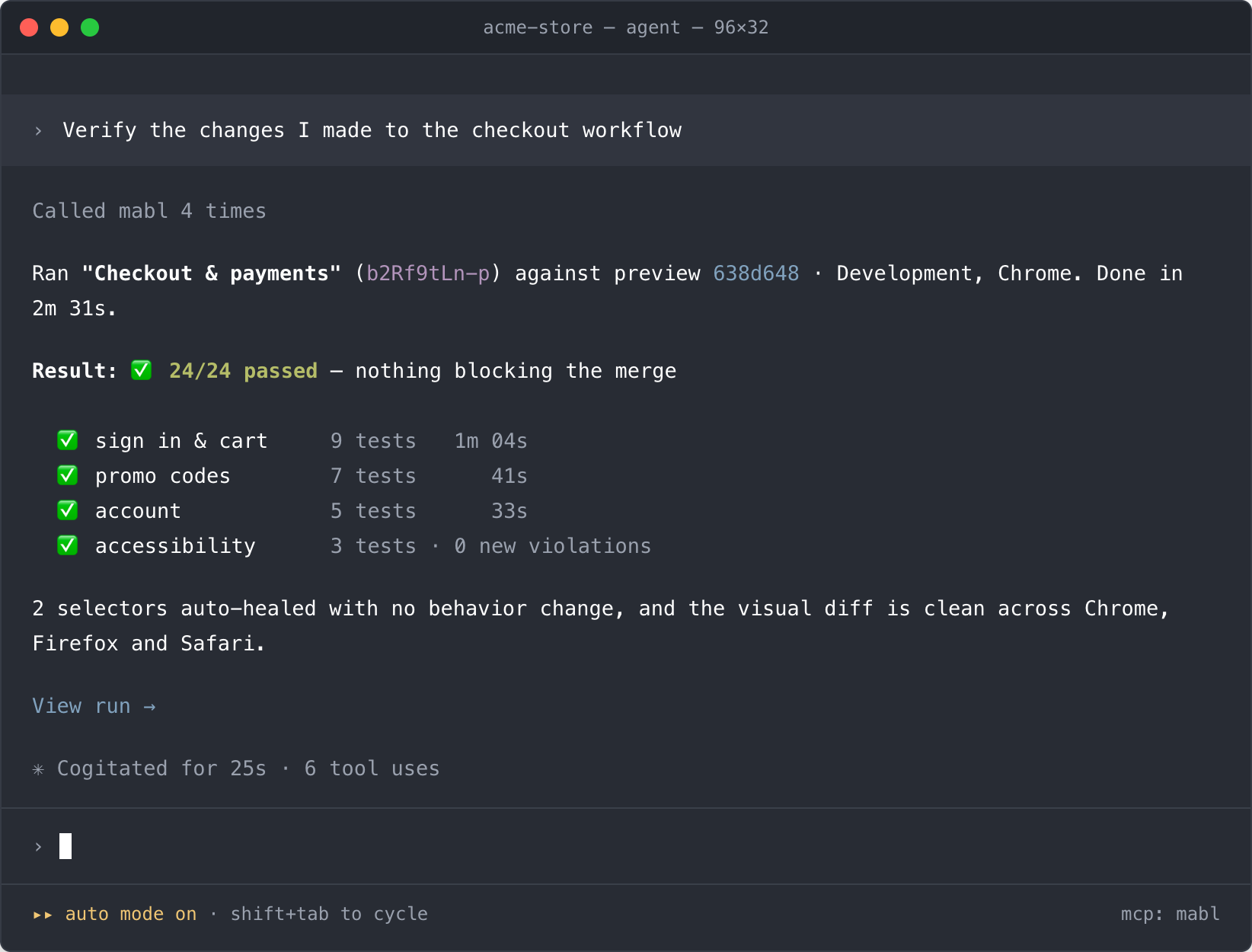
An LLM told to make a test pass will edit the DOM or weaken the assertion to get there. mabl runs your deployed app in a real browser, in a separate context, and checks it against assertions you defined separately.
-
Your intent, translated
You describe what to test and set your guardrails; mabl's tuned metaprompts turn that into the structured instructions the agent runs on, scoped per agent with mabl's own guardrails winning on conflict. You get an effective agent without prompt-engineering it yourself.
-
Deterministic first, LLM when needed
Cheap deterministic locators run first; the model engages only when they fail. More efficiency, lower cost, faster.
Integrate with your coding agent for fast E2E testing
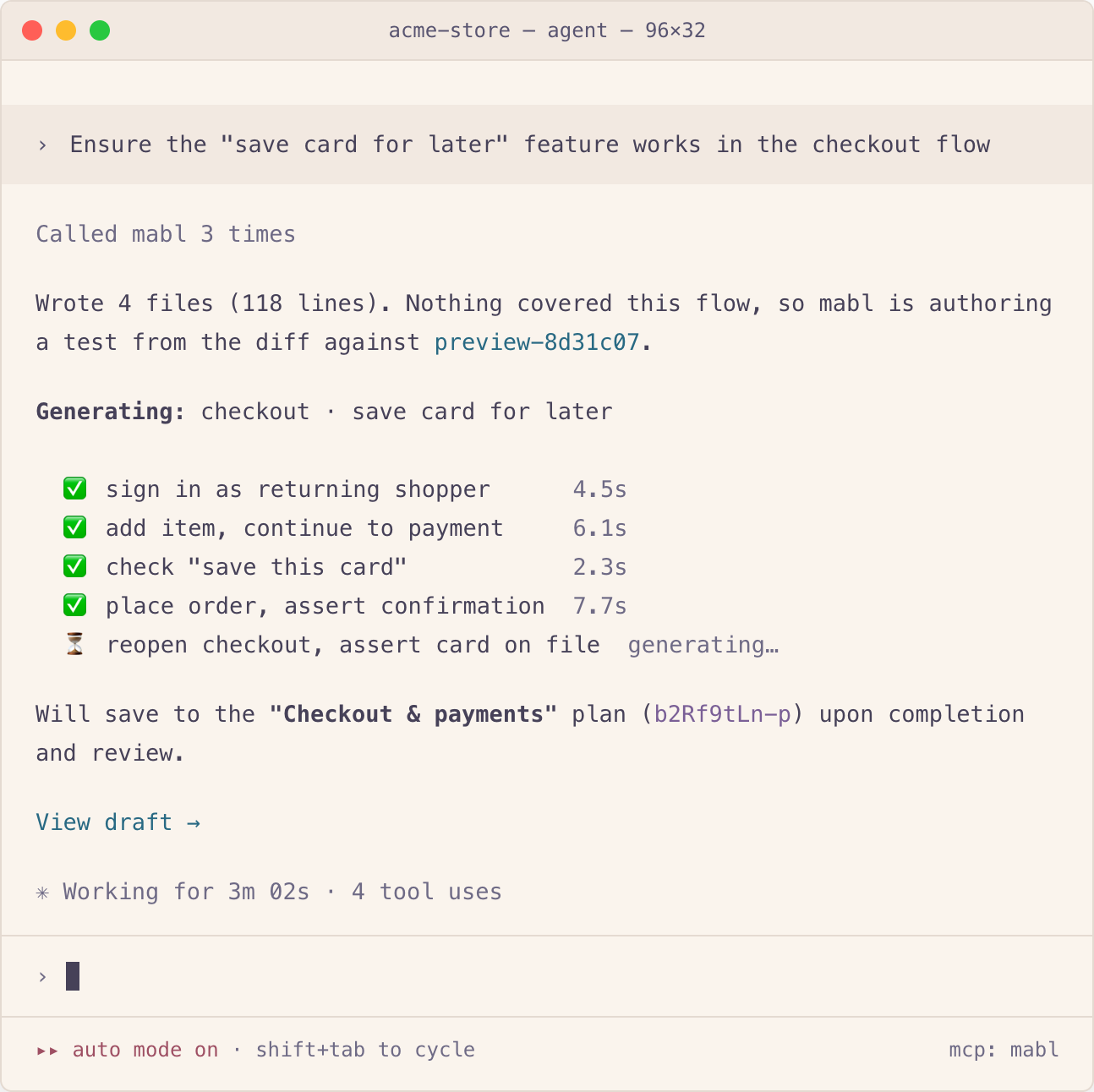
Connect the mabl MCP server or CLI, and your agent can test changes in your target environments and troubleshoot failures. All from your IDE or terminal.

-
Per-task LLM routing
The best model for each testing job. You don't need to worry about upgrades, prompt rewrites, version pinning, or evals.
-
Reliable tools for your agent
An MCP for the full testing loop. Broad tool coverage, progressive disclosure, idempotent writes, token-efficient, streaming with keepalive, OAuth.
-
Self-healing off a model, not a selector
Every element is modeled as dozens of weighted attributes, so a page change re-identifies it by best overall match, falling back to locating it visually when attributes aren't enough.
-
Structural objectivity
An LLM told to make a test pass will edit the DOM or weaken the assertion to get there. mabl runs your deployed app in a real browser, in a separate context, and checks it against assertions you defined separately.
-
Your intent, translated
You describe what to test and set your guardrails; mabl's tuned metaprompts turn that into the structured instructions the agent runs on, scoped per agent with mabl's own guardrails winning on conflict. You get an effective agent without prompt-engineering it yourself.
-
Deterministic first, LLM when needed
Cheap deterministic locators run first; the model engages only when they fail. More efficiency, lower cost, faster.
Meet the teams verifying in real-time
-
Read the SealingTech customer story
86%
Reduction in test execution time

-
Read the customer story
85%
Reduction in pre-release cycle time

-
Read the RICS customer story
108
Hours saved per cycle

Works where your team already lives
Verify your code works from commit to production
Frequently Asked Questions
How do I connect mabl to my coding agent?
Connect the mabl MCP server or the mabl CLI to your coding agent. Your agent can then run end-to-end tests against your target environments and troubleshoot failures without leaving your IDE or terminal.
Which coding agents and IDEs does mabl work with?
mabl works with coding agents including Claude Code, OpenAI Codex, GitHub Copilot, Google Gemini, and Atlassian Rovo. Teams connect through the mabl MCP server or CLI, and can also run mabl in CI with GitHub Actions.
How do you catch mistakes in code written by a coding agent?
Test the running application, not just the diff. End-to-end tests in a real browser show whether a change breaks a user workflow. mabl runs your deployed app in a separate context and checks it against assertions you define separately from the agent.
Is AI-generated code safe to merge without independent testing?
No. Code can compile and pass local checks while still breaking a workflow, and the author cannot be the verifier. Independent verification, such as end-to-end tests in your target environments, gives you evidence before you merge.
Why do coding agents need end-to-end tests, not just unit tests?
Unit tests check code in isolation, but users experience the whole application. End-to-end tests verify complete journeys in the deployed app and catch broken integrations that unit tests miss. With mabl, your agent can run them from your IDE or terminal.