





MCP is having a moment. Every testing vendor is shipping an MCP server. But most of what's out there follows the same pattern: expose existing API endpoints through MCP, add some tool descriptions, and let the LLM do the rest.
That works for simple queries, but can break down when you need a real answer. Is this failure flaky or is it a real regression? Has this pattern appeared before? Which team should own the fix?
That kind of answer requires intelligence inside your tools, not just an interface in front of them.
The Difference Between an API Wrapper and a Testing Toolkit
Most MCP testing integrations wrap REST calls in tool descriptions and let the coding agent reason about the response.
If the tool returns a list of failed tests, the agent reads the error messages and does its best to interpret them. Sometimes that's fine. For a simple "Did this test pass?" query, it doesn't matter much.
But for failure triage, the question of whether a failure is a real regression, a flaky test, or a UI change that broke your assertions, a raw error message isn't enough. The answer depends on context: what's happened to this test over the past hundred runs, whether this pattern has appeared before, whether it's consistent across retries.
An LLM only has the context that you give it
That's the core design decision we made with the mabl cloud MCP server. Each tool is backed by a real agent workflow. When you invoke failure analysis, you're not asking your coding agent to interpret a stack trace. You're triggering a multi-step pipeline that cross-references your test suite's historical data, retry patterns, and flakiness signals.
It then returns an answer, not raw output for the agent to guess at. The intelligence is in the tool, not in the prompt.
The same applies to test creation, which validates before saving. And to test recovery, which uses test intent to decide whether to intervene mid-run. And to deployment monitoring, which clusters failures by pattern as they surface and distinguishes test-update issues from real regressions.
These are far from convenience wrappers. They're purpose-built testing tools.
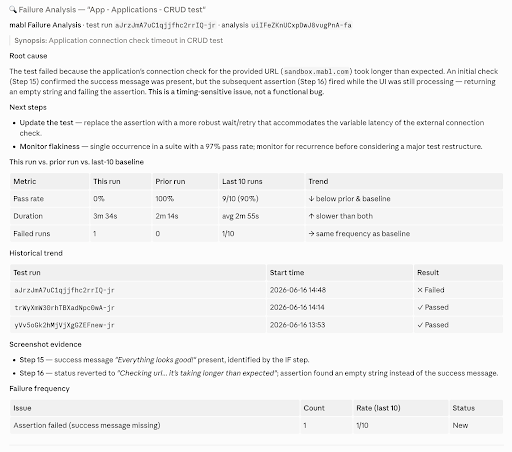
This isn't the LLM interpreting an error message. It's mabl's Failure Analysis pipeline doing the work.
One Server, the Full Testing Lifecycle
The mabl cloud MCP server currently exposes around 80 tools. That number matters less than what they cover: the full testing lifecycle, from a single server, without fragmentation.
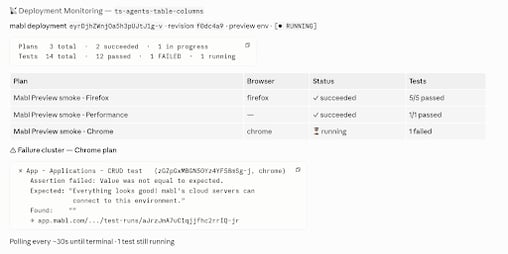 One server. Every surface.
Most MCP integrations in the testing space cover a slice. Test creation, usually. Maybe execution. The rest of the lifecycle — failure analysis with historical context, test recovery, deployment monitoring, quality metrics reporting, Xray test case management, agent instructions — either isn't there or lives in a separate server your team has to wire up separately.
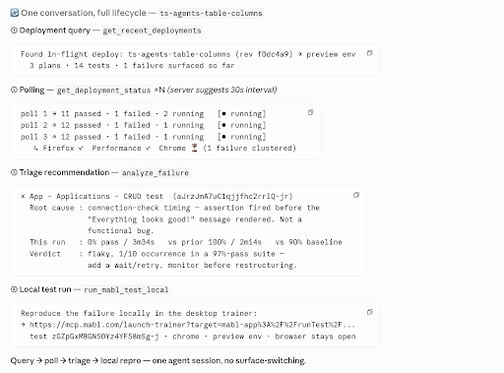
We took a different approach. One server. One URL. Always current, because it's cloud-hosted. And the tools compound. One conversation can span deploying code, watching failures surface in real time, getting a triage recommendation that distinguishes "update the tests" from "this is a real regression," running the failing test locally to debug on your machine, and filing a Jira ticket with full context. No context switching. No stitching together separate integrations.
mabl’s cofounder, Dan Belcher, walked through this exact workflow. The coding agent recognized failure patterns and made a triage recommendation before being asked, and.mabl's data was surfaced through the right interface at the right moment.
 The same story plays out on a different surface. QA engineers and product managers can query mabl from inside Jira via Atlassian Rovo. Why a test failed, whether a deployment is ready for release, a test generated from a ticket's acceptance criteria. The tool set is the same. The surface is different.
What This Architecture Enables Next
Two things become possible when intelligence lives inside the tools.
The first is API key authentication. Previously, connecting to the mabl MCP server required a browser-based OAuth flow. That's fine for a developer configuring their IDE once. It's a blocker for agent-to-agent workflows.
Scenarios where a CI system or an automated pipeline needs to call mabl without a human in the loop. API key auth removes that blocker. You generate a key, configure it once, and mabl becomes reachable from automated systems without manual re-authentication.
The second is composability. The 80+ tools are individual functions. You can call them in any combination. Power users are already building custom workflows: trigger a specific test on deploy, pull failure analysis only for certain test plans, generate reports on a schedule.
Less technical users get guided experiences through the Rovo integration or through pre-built workflows in their coding agent. The same server, different entry points, depending on what you need.
And because the server is cloud-hosted, your team doesn't manage versions. When we ship a new tool or update an existing one, it's available immediately. No CLI update. No local installation. No version drift across a team where some people updated last month and some didn't.
That last point is what makes this infrastructure rather than a plugin. A plugin you install, configure, and maintain. Infrastructure you connect to, and it handles the rest.
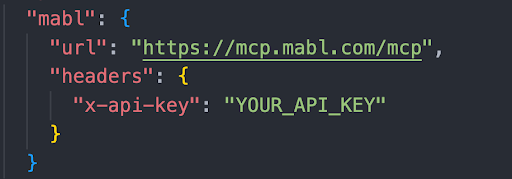 With apiKey Authorization
Getting Started
The cloud MCP server connects with a single URL. OAuth handles auth for individual developers; API keys handle auth for automated systems. It works with Claude Code, Cursor, VS Code with Copilot, Atlassian Rovo, or any MCP-compatible client.
If you're already using mabl, the simplest way to start: after your next deployment, ask your coding agent to check the results. No deployment ID needed. Watch what it surfaces.
Full documentation and setup instructions can be found at mabl.com/mabl-mcp-server.
If you're not yet using mabl and you're evaluating what an MCP-connected testing platform actually looks like against your own stack, the best next step is a demo. Request one here.