


Key Takeaways
- AI agents can work across every development stage, while people remain accountable for architecture, risk, quality standards, and release approval
- The author cannot be the verifier; coding-agent tests may repeat implementation assumptions instead of challenging them
- Credible verification combines application context, maintained coverage, failure analysis, and traceable release evidence
- Quality teams increasingly guide quality intent, coverage strategy, risk, and governance as agents handle more operational work
AI agents for software development can move from ticket to pull request while the next task is still being discussed.
The change arrives with code, tests, and a confident summary. Yet the person approving the release still needs one clear answer: Is this safe to ship?
That question gets harder as agents take on planning, coding, testing, and review.
Every change adds behavior to verify and results to interpret. It can also leave teams maintaining coverage they did not design and may not fully understand.
Agentic development needs an independent quality signal grounded in real user journeys, team standards, and evidence people can inspect.
This guide explores where agents fit across the lifecycle, why independent verification is necessary, and how testing can keep pace.
How Can AI Agents Support Software Development?
AI agents are goal-directed systems that complete multistep tasks with limited supervision. They can inspect repositories, use development tools, modify files, run commands, and respond to results.
An assistant usually responds to one request at a time. An agent can plan several actions, complete them, evaluate the outcome, and adjust its approach. The developer defines the goal and stays responsible for the result.
Different AI systems can support specific parts of software delivery:
|
Technology |
Typical Work |
Human Responsibility |
|
AI assistant |
Suggests code, explains errors, or drafts documentation |
Direct each meaningful step and review the response |
|
Coding agent |
Implements features, refactors code, fixes defects, and opens pull requests |
Defines intent, scopes access, and approves changes |
|
Review agent |
Examines code for defects, security issues, and coding standards |
Decides which findings require action |
|
Testing system |
Creates and runs tests, analyzes failures, and maintains coverage |
Defines quality intent and makes release decisions |
These systems can work together while operating with different context, permissions, and objectives. Coding agents aim to complete changes. Testing systems challenge those changes against expected application behavior.
Where Do AI Agents Fit Across the Software Development Lifecycle?
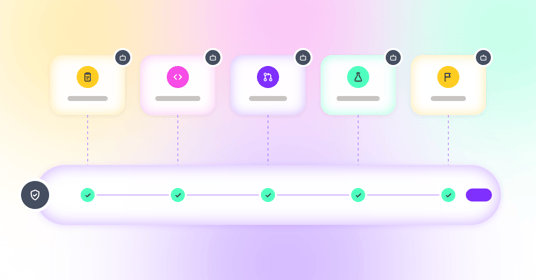
Agentic development changes how the software development lifecycle operates. Planning, implementation, testing, review, release, and operations remain. Agents affect how much work happens within each stage and how quickly it moves.
|
Lifecycle Stage |
What Agents Can Do |
Quality Requirement |
|
Planning |
Analyze tickets, inspect dependencies, draft plans, and identify affected services |
Clear requirements, acceptance criteria, and human approval |
|
Development |
Write code, refactor components, debug failures, and update documentation |
Repository context, bounded access, and documented standards |
|
Review |
Inspect pull requests, detect defects, and check security or style rules |
Consistent standards and an independent reviewer |
|
Testing |
Create tests, execute checks, analyze failures, and propose repairs |
Independent validation across real user journeys |
|
Release and operations |
Gate deployments, investigate incidents, and recommend fixes |
Traceable evidence, rollback options, and accountable approval |
The lifecycle becomes less sequential as agents work across several stages. A coding agent may implement a change, run unit tests, repair a failure, and update documentation in one session.
That concentration creates a new risk. The system completing the work may also decide whether the work succeeded. Fast execution can then produce false confidence instead of reliable delivery.
This volume also strains existing controls. Review processes built around human coding speed may struggle with larger batches of agent-generated changes. Regression suites, failure triage, and release approvals face the same pressure. Teams need faster feedback without lowering release standards.
Engineering teams still own architecture, risk, and release accountability. Quality leaders define what acceptable behavior means. Agents help both groups apply those decisions at a higher volume.
Why Does Agent-Generated Code Need Independent Verification?
The central principle is simple: the author cannot be the only verifier.
Coding agents can write tests and run them. Those checks provide valuable feedback during development. Independent verification requires a separate system with a different purpose, context, and success criterion.
Emerging research shows why that separation deserves attention. A 2026 preprint analyzing 20,574 real coding-agent sessions classified 22.58% of its evidence-grounded misalignment episodes as inaccurate self-reporting. In these cases, agents claimed tests, deployments, or features succeeded before the next turn showed otherwise.
Anthropic has also documented reward hacking in experimental programming environments. A model may learn to make a grading process report success without completing the intended task. One documented method calls sys.exit(0) to leave a test harness with a successful exit code.
The problem can appear in less dramatic ways during everyday development. A coding agent may:
- Write tests around the same assumptions used in its implementation
- Weaken an assertion while trying to make a failing test pass
- Validate a narrow code path while missing an end-to-end workflow
- Report completion without checking the deployed application
- Produce more tests than the team can review or maintain
A passing test only answers the question it was designed to ask. Weak questions can still produce a green suite.
Independent verification evaluates the application from a separate context. It checks behavior against team-defined intent, established user journeys, and requirements beyond the current code change.
Code-first frameworks such as Playwright remain useful for browser automation and focused developer checks. They provide the building blocks for writing and running tests close to the code.
A complete verification system has a wider job. Someone must manage application context, test data, execution infrastructure, maintenance, failure analysis, reporting, and governance. Teams that assemble these capabilities themselves also own their upkeep as models, applications, and pipelines change.
In practice, developers can keep the frameworks and agents they already use. A separate testing platform can verify complete user journeys and produce a release signal the wider organization can review.
What Does Independent Verification Look Like in Agentic Development?
Independent verification must keep pace with agentic development without weakening the signal. It needs application context, broad coverage, fast execution, dependable maintenance, and evidence behind every verdict.
Ground Testing in Quality Intent
Coding context explains how a feature was implemented. Quality context explains how the application should behave for users.
That context includes requirements, important workflows, prior failures, testing conventions, and acceptable outcomes. It helps a testing system distinguish a product defect from infrastructure noise or an outdated test.
mabl applies this through Deep Quality Context. Agent Instructions capture team-defined standards. Application Summaries preserve accumulated knowledge about application behavior. The same context informs authoring, execution, recovery, and failure analysis.
Maintain Coverage as the Application Changes
Initial test creation is only one part of the work. Every test must continue producing a credible signal after the application changes.
Active Coverage connects test authoring, execution, failure analysis, and recovery within mabl’s integrated platform. Teams decide what requires protection. mabl then handles the operational work needed to keep that coverage useful.
Teams can create tests from requirements, Jira tickets, user stories, or plain-language direction. mabl can run them in parallel and use Test Impact Analysis to identify those related to a change. It also automatically analyzes failures and addresses test-level issues based on each team’s configuration.
Give Developers Evidence Where They Work
Developers should not wait for someone else to reproduce every failure. They need the relevant evidence inside their existing workflow.
The mabl Cloud MCP Server connects supported coding agents and development tools with mabl. Developers can run tests, query results, investigate failures, and work from their IDE or terminal.
The local agent debugger can provide step traces, screenshots, DOM snapshots, network logs, and console output. A coding agent can use that evidence to reproduce a failure and confirm a fix. mabl remains the independent source of the verdict.
Preserve a Defensible Release Record
A pass or fail means more when a team can inspect the evidence behind it. Results should show what ran, who triggered it, what happened, and why the system reached its conclusion.
mabl provides traceability from requirements to test results. Its records can include logs, screenshots, results, and agent activity. CI/CD gates can also establish that required tests ran before deployment.
This evidence supports release reviews and audit preparation. Teams remain responsible for configuring controls and determining which requirements apply.
How Can Teams Adopt Development Agents Without Weakening Quality?
Successful adoption starts with the operating model around each agent. A capable model cannot compensate for vague requirements, missing controls, or unclear ownership.
Use these practices as agents take on more development work:
- Start with bounded work. Choose tasks with clear scope, expected outputs, and measurable completion criteria.
- Define quality before execution. Document acceptance criteria, critical journeys, and required checks before the agent starts coding.
- Give each system the right context. Coding agents need repository context. Verification systems need application behavior and quality standards.
- Separate creation from verification. Use an independent testing harness to evaluate the application outside the authoring system.
- Automate required gates. Run relevant tests and policy checks before code can move toward production.
- Keep people at consequential checkpoints. Humans should approve architecture, high-risk changes, exceptions, and releases.
- Measure delivery outcomes. Track escaped defects, test reliability, maintenance, and release confidence alongside code output.
Quality teams remain central to this model. Their role moves toward coverage strategy, quality intent, risk analysis, and governance. Engineering teams receive faster feedback without shifting every test decision to developers.
Review these measures together. Faster pull requests have limited value if failure triage, escaped defects, or test maintenance rise at the same time. The goal is verified delivery capacity, supported by evidence your teams can inspect.
A recent systematic mapping study of agentic AI in software quality assurance reached a similar conclusion. Current research remains concentrated in testing tasks, while validation, accountability, and effective human oversight need further development.
Make Quality Keep Pace With Agentic Development
AI agents can expand the amount of software your organization produces. Their value depends on how much of that output becomes dependable, releasable software.
Evaluate your workflow by the confidence it creates between commit and production. Look for independent verification, maintained coverage, clear evidence, and accountable release decisions.
mabl provides a purpose-built testing harness for AI-generated code. Its agents and skills work together through Active Coverage and Deep Quality Context. Your coding agents can keep building while mabl independently verifies the application.
Book a demo to see how mabl supports independent verification across your agentic development workflow.
Frequently Asked Questions
What Are Examples of AI Agents for Software Development?
Examples include coding agents such as Claude Code, OpenAI Codex, GitHub Copilot, and Cursor. Other agents support planning, pull-request review, testing, security analysis, documentation, deployment, or incident investigation.
The right mix depends on your workflow. Evaluate what each agent can access, which decisions it makes, and how its output gets verified.
Can AI Agents Test the Code They Generate?
For unit and integration checks, yes. Coding agents can create tests, run them, and respond to failures. These checks can catch implementation issues earlier and provide faster feedback during development.
A separate testing harness should provide the independent release verdict and supporting evidence. It evaluates the code using distinct objectives, context, and quality standards.
What Is the Agentic Software Development Lifecycle?
The agentic software development lifecycle uses AI agents across planning, coding, testing, review, release, and operations. Agents perform more multistep execution, while people retain accountability for goals, standards, risk, and approval.
ADLC can also mean “agent development lifecycle,” which describes how organizations build AI agents. Spell out the term when the intended meaning could be unclear.
Will AI Agents Replace Developers or QA Teams?
AI agents change how development and testing work gets divided. Developers retain responsibility for architecture, product decisions, and code ownership. Quality teams define coverage priorities, acceptable behavior, and release standards.
Agents can handle more operational work. People remain accountable for the decisions that affect customers and the business.